
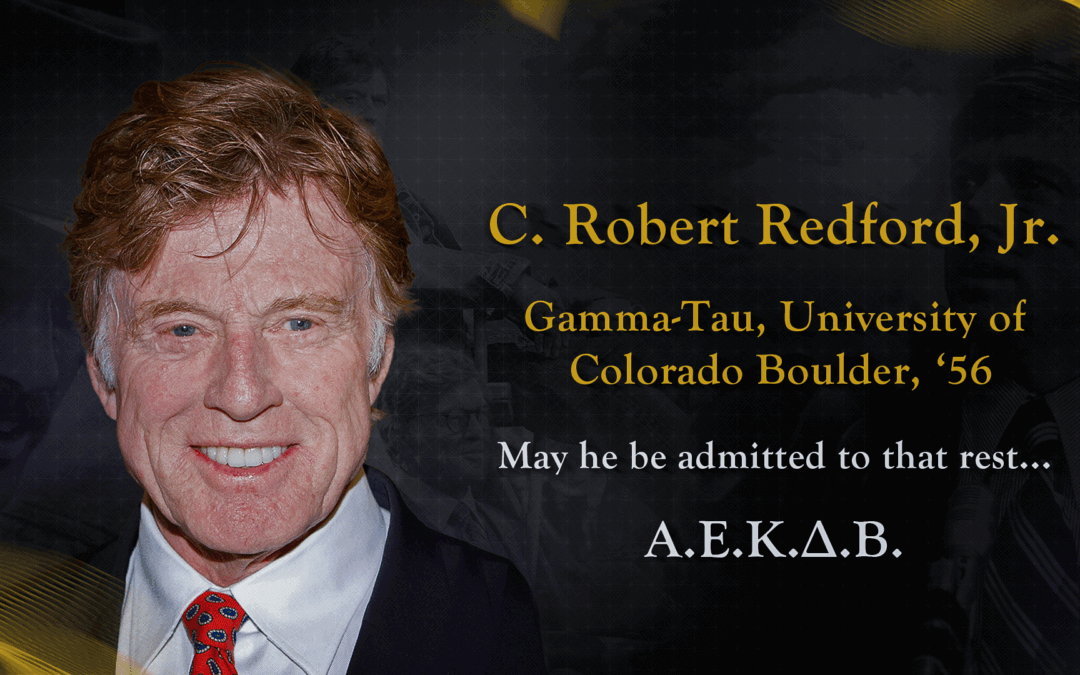
Acclaimed Actor, Director, and Sundance Film Festival Founder Charles Robert Redford, Jr. (Gamma-Tau, University of Colorado Boulder, ’56) was born on August 18, 1936, in Santa Monica, California, and entered into Chapter Celestial on September 16, 2025.
After graduating from high school in 1954, he attended the University of Colorado in Boulder where he was a member of the Gamma-Tau Chapter, initiated in 1956. Today, the Kappa Sigma Headquarters has multiple autographed items on display from movies such as Butch Cassidy and the Sundance Kid (1969) and The Natural (1984).
Robert Redford’s major breakout role was in George Roy Hill’s Butch Cassidy and the Sundance Kid (1969). Redford won a British Academy of Film and Television Award (BAFTA) for that role and his parts in Downhill Racer. Butch Cassidy and the Sundance Kid (1969) also placed as the No. 10 highest-grossing film for 1974, as it was re-released due to the popularity of The Sting.
In 1974, he starred in the romantic drama The Great Gatsby (1974). The film was the No. 8 highest-grossing film of 1974. In 1974, Redford became the first performer since Bing Crosby in 1946 to have three films in a year’s top-ten-grossing titles. Each year between 1974 and 1976, movie exhibitors voted Redford Hollywood’s top box-office star.
With his acting success from Butch Cassidy and the Sundance Kid and Downhill Racer, Redford bought a ski area on the east side of Mount Timpanogos northeast of Provo, Utah, called “Timp Haven,” and renamed it “Sundance” after his character. Redford went on to create the annual Sundance Film Festival, the country’s largest festival for independent films.
Redford was the President and Co-Founder of Sundance Productions, with Laura Michalchyshyn. Since founding the nonprofit Sundance Institute in Park City, Utah, in 1981, Redford had been deeply involved with independent film. Through its various workshop programs and popular film festival, Sundance has provided support for independent filmmakers. In 1995, Redford signed a deal with Showtime to start a 24-hour cable television channel, The Sundance Channel, devoted to airing independent films.
In 1976, Robert Redford co-starred with Dustin Hoffman in All the President’s Men, the second-highest-grossing film of the year. All the President’s Men was a landmark film for Redford, reflecting his offscreen political concerns through its serious subject matter—the Watergate scandal—and its realistic portrayal of journalism.
His first film as director was the drama film Ordinary People (1980), a drama about the slow disintegration of an upper-middle class family after the death of a son. The film is one of the most critically and publicly acclaimed films of the decade, nominated for six Academy Awards, including Best Director, which Redford won.
In 2008, Redford received The Dorothy and Lillian Gish Prize, one of the most prestigious prizes in the arts, given annually to “a man or woman who has made an outstanding contribution to the beauty of the world and to mankind’s enjoyment and understanding of life.”
In April 2014, Redford played the main antagonist of the Marvel Studios superhero film Captain America: The Winter Soldier, Alexander Pierce, the head of S.H.I.E.L.D. and leader of the Hydra cell. He briefly reprised his role as Alexander Pierce for a cameo appearance in Avengers: Endgame.
Redford played bank robber Forrest Tucker in the David Lowery directed drama film The Old Man & the Gun, which was released in September 2018, and for which he received a Golden Globe nomination.
In 2017, he was awarded the Golden Lion for Lifetime Achievement at the 74th Venice Film Festival. In 2019, Redford received the Honorary César at the 44th César Awards in Paris. Redford also won a DGA Award Winner for Ordinary People, and is a four time Oscar Nominee.
In 1996, he was awarded the National Medal of Arts from President Bill Clinton. In 2010, Redford was appointed chevalier of the Légion d’honneur by President Nicolas Sarkozy. On November 22, 2016, President Barack Obama honored Redford with a Presidential Medal of Freedom. In December 2005, he received the Kennedy Center Honors for his contributions to American culture.
Recent Comments